

Bottom line: A 14-base-pair deletion in the POMC gene, reported by University of Cambridge researchers in 2016, adds on average about 1.9 kg of body weight and roughly 10% more owner-rated food motivation per copy in Labrador Retrievers. It was far more common in UK assistance-dog breeding stock (allele frequency 45%) than in pet Labradors (12%), possibly because food-driven dogs are easier to train. Yet the 2025 Science genome scan of 241 British Labradors found POMC on its own was not significant: DENND1B and other loci, plus how tightly owners controlled food and exercise, explained more. A carrier is not destined to be obese and a clear dog is not protected. Body fat is judged with a veterinarian’s body condition score; weight assessment and any weight-loss plan belong with your vet.
If you share a home with a Labrador that patrols the kitchen floor, the question in the search bar is usually “why is my Lab always hungry?” Science has a partial answer. It runs through guide-dog kennels, a sealed box with a sausage inside, and a genome scan that cut the famous “obesity gene” down to size.
- Why would the dogs bred to guide people carry more of a hunger variant?
- Beta-MSH and beta-endorphin go missing; the stress-hormone part stays intact
- Hungrier between meals, but no slower to feel full
- 241 Labradors, seven signals, and no significant POMC hit
- Neutering, coat colour and a vet’s notes also predict a heavier Lab
- How a POMC result is produced, and why labs disagree on its label
- What one genotype can and cannot tell you about your dog
- From the family vet to a board-certified nutritionist
- Overweight exclusions, ombudsman rulings and US policy wording
- Frequently asked questions
- Related articles
- References
- How to get your pet tested
Why would the dogs bred to guide people carry more of a hunger variant?
The first large genotyping of the POMC deletion, published in Cell Metabolism by Eleanor Raffan’s team at the University of Cambridge Metabolic Research Laboratories, compared two kinds of Labrador. Pet dogs were recruited after the UK Kennel Club emailed more than 15,000 Labrador owners, or through participating vet practices. A separate set of 81 Labradors used as assistance-dog breeding stock was sampled by Guide Dogs UK; the paper’s acknowledgements thank Rachel Moxon of that charity for collecting them.
The contrast was stark:
| Group (Raffan 2016) | Dogs | No deletion | One copy | Two copies | Allele frequency |
|---|---|---|---|---|---|
| UK pet and general Labradors | 383 | 78% | 20% | 2% | 12% |
| US Labradors | 28 | genotype split not given | same as UK | ||
| UK assistance-dog breeding stock | 81 | 23% | 64% | 12% | 45% |
Allele frequency counts copies of the deletion across all chromosomes in a group, so it is not the share of dogs that carry it. In the breeding stock, only 23% of dogs had no copy at all. The genotype counts there also departed from Hardy-Weinberg equilibrium (p<0.01), with more heterozygous dogs than random mating would predict. That pattern hints at selection.
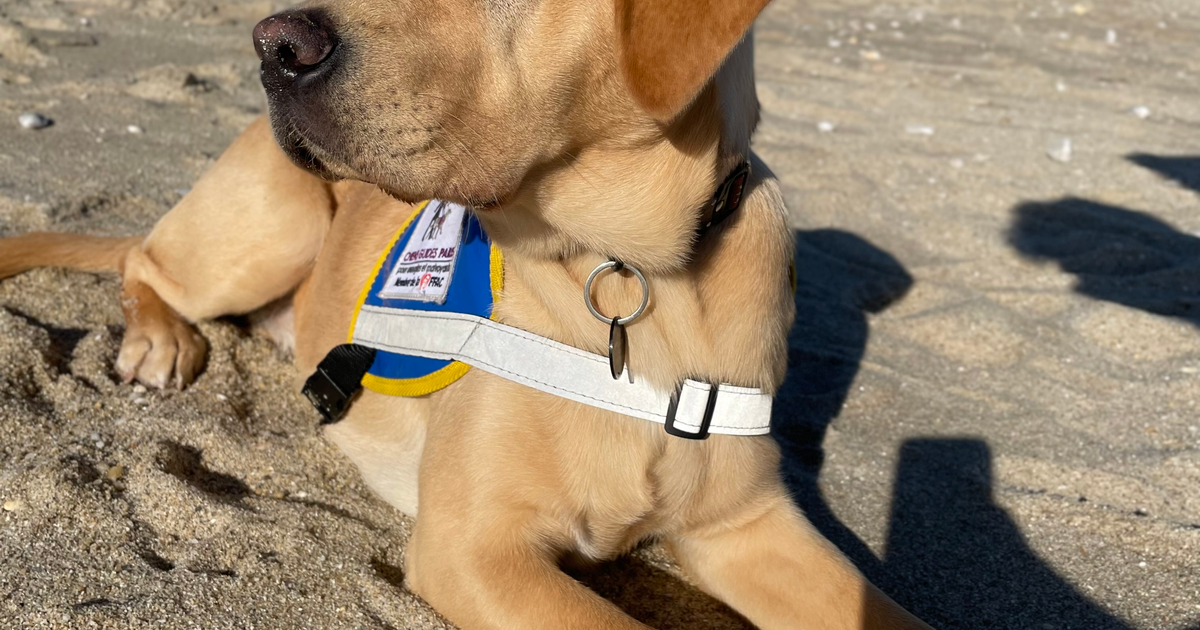
SamDoes that mean guide-dog charities picked these dogs because of the gene? Elena MarshNo charity selected on POMC; the test did not exist. The Cambridge authors offered a hypothesis: puppies that work hard for a food reward train well, so food-driven dogs may have been kept for breeding without anyone knowing why.That hypothesis fits how assistance-dog programmes describe themselves. Guiding Eyes for the Blind’s 2026 fact sheet says more than 500 pups are born each year in its programme, 90% of them Labrador Retrievers, and that raising and training rely on “play and food rewards”. Guide Dogs UK lists the Labrador and several Labrador crosses among its breeds, and Guide Dogs for the Blind in the US states that Labradors make up the largest share of its breeding colony. None of these organisations’ pages mention POMC, and nothing here suggests any of them screen for it or select for it. The selection idea remains a hypothesis; no one has shown that trainability is what raised the frequency.
The paradox is worth spelling out. The dogs society trusts most for calm, focused work are also the ones most likely to carry a variant that makes food more compelling. For the assistance-dog world, that hunger may be part of what makes a puppy eager to learn. For a pet household, the same trait shows up as a dog that never seems satisfied.
Beta-MSH and beta-endorphin go missing; the stress-hormone part stays intact
POMC stands for pro-opiomelanocortin, a precursor protein that the body cuts into several smaller signalling molecules. In dogs the gene sits on chromosome 17 (NCBI Gene 403659). The variant is catalogued in OMIA 001258-9615, the database’s entry for obesity in dogs, which classifies the trait as multifactorial rather than single-gene. A 2017 UK study by Davison and colleagues later placed the deletion in exon 3.
Losing 14 base pairs shifts the reading frame (p.E188fs). According to the 2016 paper, that shift wipes out the coding sequence for two products, beta-MSH and beta-endorphin, while the upstream part that yields ACTH and alpha-MSH is untouched. Carriers in the later Cambridge work had normal ACTH, T4 and TSH, so there was no sign of cortisol deficiency or an underactive thyroid. Beta-MSH is one reason the dog is a useful model for people: rodents never make it, whereas humans and dogs do.
In the Labrador cohort the effects added up copy by copy, after adjusting for age, sex, neuter status and coat colour:
- body weight: +1.90 kg per deletion allele (0.33 standard deviations, p<0.0001);
- body condition score: +0.48 points per allele on the 9-point scale;
- food motivation: +9.9% per allele on the owner-completed questionnaire (p=0.001).
The authors pointed out that this per-allele effect is more than three times that of the FTO variant in humans. That is notable, they wrote, because owners rather than dogs decide how much food and exercise a dog gets.
Across 38 other breeds the deletion did not turn up. It appeared only in Labradors and Flat-Coated Retrievers, and identical flanking markers in both suggest a single ancestral origin, plausibly the extinct St. John’s water dog from which both breeds descend. A Polish study of 272 dogs from four obesity-prone breeds found it only in Labradors and not in Golden Retrievers, Beagles or Cocker Spaniels.
Hungrier between meals, but no slower to feel full
“Always hungry” can mean several things. A dog might want food more, enjoy it more, or simply fail to register when it has had enough. The 2024 follow-up in Science Advances, led by Dittmann with Raffan as senior author, tried to separate those strands in UK pet dogs. The university’s press release describes 87 adult pet Labradors, all lean or moderately overweight, taking part in a set of tests.
In the “sausage in a box” test, a sausage was sealed in a box with holes, so the dog could smell it but not reach it, three hours after a standard meal. Among 36 Labradors (18 without the deletion, 16 with one copy and 2 with two copies), dogs with the deletion spent significantly more time nosing and pawing at the box. That is “wanting”: drive for a food cue the dog cannot have.
Satiety told a different story. In a modified all-you-can-eat meal with 24 dogs (14 without the deletion, 10 with one copy), intake did not differ significantly between genotypes. Carriers ate faster, yet in a separate palatability test of 24 dogs (13 without, 11 with one copy) they told palatable food from unpleasant food as well as non-carriers did, so “liking” looked normal. One unexpected detail: 9 of 16 non-carrier dogs vomited or regurgitated at the end of the large meal compared with 1 of 12 carriers, which the authors read as a possible genetic difference in tolerating big meals. It is a laboratory observation, not something to test at home.
SamSo a carrier Lab isn’t greedier at the bowl, just more obsessed with food it can’t reach? Elena MarshIn that 2024 study, yes: drive for unreachable food rose while the point of fullness did not shift. A second finding, from calorimetry in Flat-Coated Retrievers, concerned how much energy the body burns at rest.Resting metabolic rate was measured by indirect calorimetry in 19 lean, intact Flat-Coated Retrievers aged two to seven years. The 10 dogs with two copies used significantly less energy at rest than the 9 without the deletion, about 25% less for an adult-weight dog. That is a double hit: hungrier and burning less while lying down. Two cautions matter. The measurement was made only in Flat-Coated Retrievers with two copies; heterozygous dogs and Labradors were not measured. And only about 4% of Labradors carry two copies, which is why homozygous Labradors could not be recruited for the feeding tests.
Blood pressure was lower in carrier Labradors (mean systolic 128 mmHg versus 140 mmHg in non-carriers; 21 dogs, P=0.003), both values within the normal range. The researchers described affected dogs as clinically healthy.
241 Labradors, seven signals, and no significant POMC hit
If POMC were the master switch for Labrador weight, a genome-wide scan should find it easily. The 2025 study by Wallis and colleagues in Science, again from Raffan’s group, ran exactly that scan on body condition in 241 British Labradors, mostly pets plus some working dogs. The strongest signal was in DENND1B: each alternate allele was linked with about 7.5% more body fat, and the same gene was associated with body mass index in human data. The authors report that DENND1B regulates signalling through MC4R, a receptor in the melanocortin appetite pathway. Seven independent signals emerged in total, near genes such as CSNK1A1, SEMA3D and CDH8.
POMC itself (written p.P187fs in that paper, minor allele frequency 0.14) was not significantly associated with body condition. The authors gave reasons: the deletion is commonest in assistance-dog lines that were not part of this sample, its frequency is low, its effect modest and its penetrance variable. Their phrase for the overall picture was a “complex genetic architecture of canine obesity”.
Two further findings sharpen the guide-dog story. A 16-variant polygenic risk score built from the scan was higher in assistance-dog Labradors, and also higher in chocolate Labradors. So the extra genetic loading in assistance lines goes beyond POMC alone.
SamIf the genes stack up like that, is there any point trying to keep a high-risk Lab slim? Elena MarshThat is the most hopeful result in the 2025 paper. Among dogs with a high polygenic score, stricter owner control of diet and exercise went with lower body condition (p=0.0077); low-risk dogs tended to stay lean regardless.Put plainly, management made the most difference exactly where genetic risk was highest. The polygenic score had no predictive value in Flat-Coated Retrievers and pugs and only weak value in Golden Retrievers, so it is not a universal tool either. The paper also lists competing interests, including consultancy for a pet-food company, which readers may want to know.
Other candidate loci are less settled. A Polish analysis of 41 genes in 50 Labradors flagged an ADCY3 variant, and a genome-wide structural-variant study of 50 Labradors named suggestive regions; both groups called for validation. A 2026 paper in Molecular Metabolism found that a common Labrador variant in MC3R affected puberty timing more than obesity, a reminder that not every appetite-pathway variant is an “obesity gene”.
Neutering, coat colour and a vet’s notes also predict a heavier Lab
Genes are only one column of the ledger. A Cambridge risk-factor study of 521 British Labradors (Wallis, Sumanasekera and Raffan, Veterinary Record, 2024) found that neutering raised obesity odds in males (p<0.001) but not females, that older age mattered in females but not males, and that chocolate coat colour and high food motivation were independent risk factors. The authors noted the dogs were recruited to include lean and obese animals on purpose, so the study cannot estimate how common obesity is.
The scale matters because this is still a very common family dog: the AKC 2025 ranking places the Labrador at No. 2, after 31 years at the top, and Royal Kennel Club registrations fell from a 2021 peak of 61,559 to 29,919 in 2025 while staying high. For prevalence, UK primary-care records give one view. In a VetCompass analysis by McGreevy and colleagues (2018) of 33,320 Labradors seen in 2013, overweight/obesity was among the most common recorded disorders, at 8.8% of the 2,074-dog sample, second only to ear inflammation (otitis externa) at 10.4%. A later Royal Veterinary College study (Pegram et al., 2021) found Labradors had 1.70 times the risk of being recorded as overweight compared with crossbreeds, and warned the figures may be “the tip of the iceberg” because many heavy dogs never get the label in their notes.
In the US, the Association for Pet Obesity Prevention’s 2022 veterinary-assessed survey put 59% of dogs at body condition 6 to 9, up from 56% in 2018. APOP’s next clinic survey is collecting data from October 1 to December 31, 2026, so 59% stays the latest clinical figure for now. A separate APOP owner survey found only 27% of dog owners recalled their vet ever giving a body condition score. Those numbers measure different things (a vet’s recorded diagnosis versus a scored body condition) and should not be compared directly.
The breed standard itself is clear about fat. The AKC Labrador Retriever standard (approved 1994) says Labradors “shall be shown in working condition well-muscled and without excess fat”. The weight range it gives is a show guideline, not a target for your individual dog; body condition, felt over the ribs and seen at the waist, is the better yardstick.
How a POMC result is produced, and why labs disagree on its label
Because the variant is common in Labradors, several companies already report it. They do not all read it the same way, and they do not describe it the same way. Prices below were checked on October 21, 2026; sale prices were autumn promotions.
| Provider | How POMC appears | Method / label | Price seen |
|---|---|---|---|
| Embark (US) | In every Embark test with health testing | Linkage test, “over 98% predictive of POMC genotype” | Breed + Health US$139 on sale, US$159 regular |
| Wisdom Panel Premium | “Obesity risk (POMC)” | Labelled “Autosomal Dominant”, “Moderate likelihood” | US$159.99 list (US$127.99 in October); UK £144.99 list (£108.74) |
| Laboklin UK | “Obesity / Adiposity (ADI)”, test 8602 | Direct assay; “not a Mendelian trait”; 1-2 weeks | £48.00 including VAT |
| Genomia (Czech Republic) | POMC c.561_575del | Calls obesity “multifactorial”; 12 business days; ships internationally, so a US or UK sample is posted abroad | US$56.00 excluding VAT |
Embark’s blog says 18% of Labradors tested with Embark have the POMC variant. That is a share of dogs carrying it among Embark’s own customers, so it cannot be set against the 12% allele frequency in the Cambridge pet sample. Wisdom Panel’s “found in 1 in 53 dogs” is across every dog it tests, mixed breeds included, not Labradors. Wisdom’s cheaper Essential kit, sold as covering 25+ conditions, does not list POMC on its product page. We could not find a POMC listing at Animal Genetics, UC Davis VGL or Paw Print Genetics (now merging with Orivet); that is a gap in what we saw, not proof they do not offer it. POMC also sits outside the OFA/CHIC and Royal Kennel Club health-testing schemes for the breed.
The labels are the confusing part. Wisdom calls the inheritance autosomal dominant; Laboklin says it is not Mendelian; the Polish cohort suspected it acted recessively there, and in that group it tracked body weight but not a 5-point condition score. The Cambridge data show each copy adding a similar increment. The most defensible reading is a risk allele whose average effect grows with the number of copies. Two copies tend to show more effect, as Wisdom’s own page notes, but neither one nor two copies guarantees a heavy dog.
What one genotype can and cannot tell you about your dog
There is no trial showing that dogs whose owners learn the POMC result end up leaner than dogs whose owners do not. Keep that in mind when reading any report. Here is what the evidence supports:
- Zero copies does not protect a dog. DENND1B, neutering, age, coat colour and food motivation all contributed independently in British Labradors.
- One or two copies shifts averages, not individual destiny. Dittmann and colleagues wrote that many slim affected dogs in their cohort showed it is possible, “if hard work”, to keep them lean.
- The result does not diagnose obesity. Body fat is assessed by a vet with a body condition score; the WSAVA Global Nutrition Toolkit chart uses a 9-point scale where 4-5 is ideal.
- No link with diabetes was found: Davison’s UK case-control study of 57 diabetic and 61 non-diabetic Labradors showed no association (P=0.31).
The authors’ practical point is about expectations rather than numbers. A carrier dog may need to eat less than a non-carrier to hold the same healthy shape, and may feel hungrier doing it. Raffan’s comment in the 2024 release: “It’s very difficult to keep these dogs slim, but it can be done.” The same release mentions slowing meals down, for example with puzzle feeders or scattering the daily ration, so a highly motivated dog spends longer foraging. How much food and which food remain decisions for your vet, not for a DNA report.
For breeders, the risk-allele framing matters. POMC does not follow the carrier-times-carrier logic of a recessive disease, and Wisdom Panel’s breeder note says dogs with the mutation “can be considered for breeding” because a healthy weight can be maintained. Removing every carrier would also remove a large slice of some working lines. A result is better treated as information to pass to puppy buyers than as a pass/fail mark.
From the family vet to a board-certified nutritionist
Bring the report to a routine appointment and ask for a body condition score to be recorded, not just a scale weight. If your dog does not reach the agreed condition under the primary vet’s plan, referral is the next step. In the US, the ACVIM owner pages describe the decision to see a specialist as one made ideally with your primary care veterinarian. ACVIM certifies nutrition specialists (written DACVIM (Nutrition)), and its directory VetSpecialists.com can be searched under “Nutrition (Diet Management)”. In the UK, the RCVS Find a Vet search locates practices and shows which hold Practice Standards Scheme accreditation; specialist nutrition referrals go through your own vet.
A POMC result on its own is not a reason for referral. The trigger is a dog that stays above ideal condition despite a plan, or a dog with a related problem such as joint disease.
In England, the Defra Code of Practice for the Welfare of Dogs says a healthy adult dog should have a stable weight for its age, sex, breed and activity, “neither too thin nor too fat”. Breaching the code is not an offence in itself, but courts consider it in duty-of-care proceedings under section 9 of the Animal Welfare Act 2006. We found no comparable US federal or state rule on pet weight.
Overweight exclusions, ombudsman rulings and US policy wording
The PDSA PAW Report 2026 estimates that 67% of UK dogs are insured, and that 42% of owners give treats to make their dog feel happy. That makes weight clauses relevant to a lot of Labrador households.
Some UK policies written by Casualty & General Insurance Company (Europe) exclude claims “resulting from your pet being medically overweight”. In the seven published Financial Ombudsman Service final decisions we read (six involving that insurer, one Building Block Insurance PCC, 2022-2023), the ombudsman upheld the owner every time. The reasoning was that the insurer had to show the weight caused the condition. One decision concerned a dog at a body condition score of 7/9 that needed surgery. These seven were a search-selected sample, not every case, and we did not check the breeds involved. The practical lesson is that the vet’s weight and condition notes are what an insurer and an ombudsman read; a POMC genotype is not a weight record.
In the US, the NAIC Pet Insurance Model Act defines a preexisting condition by veterinary advice, treatment, or signs or symptoms before the policy starts or during a waiting period. A genotype is not a sign or symptom in that wording, but we found no insurer text saying how a POMC result or a recorded high body condition score is handled, so ask before enrolling. The model act also says a wellness program is separate from insurance and cannot be a condition of buying a policy. A Trupanion policy form dated 05/10 excludes feeding, exercise and special diets, so weight-management food is usually outside accident-and-illness cover; that form may not reflect current wording.
Frequently asked questions
Q. Does a POMC deletion mean my Labrador will become obese?
No. In the Cambridge data each copy added about 1.9 kg on average, yet the 2025 Science scan of 241 British Labradors found POMC alone was not significant, and many affected dogs stayed slim. Ask your vet to record a body condition score; weight assessment and any weight-loss plan belong with them.
Q. My Lab tested clear. Can I stop worrying about weight?
No. DENND1B and other loci, male neutering, age in females, chocolate coat and food motivation all predicted heavier British Labradors independently of POMC.
Q. Why are guide-dog Labradors more likely to carry the deletion?
In 81 UK assistance-dog breeding Labradors the allele frequency was 45% versus 12% in pets. The authors’ untested hypothesis is that food-motivated puppies train well and were kept for breeding. No guide-dog organisation is known to select on POMC.
Q. Is the deletion linked to diabetes?
A UK study of 57 diabetic and 61 non-diabetic Labradors found no association (P=0.31).
Q. Why does Embark report 18% of Labs while Cambridge reported 12%?
Embark’s 18% is the share of its tested Labradors carrying the variant; Cambridge’s 12% is an allele frequency in 383 UK dogs. They measure different things in different samples.
Q. Does it also occur in Golden Retrievers or Labradoodles?
It was found only in Labradors and Flat-Coated Retrievers in the studies, and was absent from Golden Retrievers in a Polish cohort. Labradoodles appear on some labs’ breed lists because of Labrador ancestry; no study reports their frequency.
Related articles
Related inherited-disease articles and the test-service coverage table.
Read about the same gene in other languages
References
- Raffan E, Dennis RJ, O’Donovan CJ, Becker JM, Scott RA, Smith SP, Withers DJ, Wood CJ, Conci E, Clements DN, Summers KM, German AJ, Mellersh CS, Arendt ML, Iyemere VP, Withers E, Soder J, Wernersson S, Andersson G, Lindblad-Toh K, Yeo GS, O’Rahilly S (2016). A deletion in the canine POMC gene is associated with weight and appetite in obesity-prone Labrador retriever dogs. Cell Metab 23(5):893-900.
- Dittmann MT, Lakatos G, Wainwright JF, Mokrosinski J, Cross E, Farooqi IS, Wallis NJ, Halsey LG, Wilson R, O’Rahilly S, Yeo GSH, Raffan E (2024). Low resting metabolic rate and increased hunger due to beta-MSH and beta-endorphin deletion in a canine model. Sci Adv 10(10):eadj3823.
- Wallis NJ, McClellan A, Morseburg A, Kentistou KA, Jamaluddin A, Dowsett GKC, et al., Raffan E (2025). Canine genome-wide association study identifies DENND1B as an obesity gene in dogs and humans. Science 387(6741):eads2145.
- Wallis NJ, Sumanasekera NT, Raffan E (2024). Obesity risk factors in British Labrador retrievers: effect of sex, neuter status, age, chocolate coat colour and food motivation. Vet Rec 194(6):e3410.
- Davison LJ, Holder A, Catchpole B, O’Callaghan CA (2017). The canine POMC gene, obesity in Labrador retrievers and susceptibility to diabetes mellitus. J Vet Intern Med 31(2):343-348.
- Mankowska M, Krzeminska P, Graczyk M, Switonski M (2017). Confirmation that a deletion in the POMC gene is associated with body weight of Labrador Retriever dogs. Res Vet Sci 112:116-118.
- Sypniewski M, Szydlowski M (2023). A study of 41 canine orthologues of human genes involved in monogenic obesity reveals marker in the ADCY3 for body weight in Labrador Retrievers. Vet Sci 10(6):390.
- Antkowiak M, Szydlowski M (2023). Uncovering structural variants associated with body weight and obesity risk in labrador retrievers: a genome-wide study. Front Genet 14:1235821.
- Duckett K, McClellan A, Corbin LJ, et al. (2026). Cross-species studies implicate the melanocortin 3 receptor more strongly in the control of pubertal development than energy balance. Mol Metab 103:102301.
- OMIA 001258-9615: Obesity in Canis lupus familiaris (dog). Online Mendelian Inheritance in Animals, University of Sydney.
- NCBI Gene ID 403659: POMC proopiomelanocortin [Canis lupus familiaris].
How to get your pet tested
Some pet DNA tests screen for hereditary-disease carrier status or genetic risk markers, but the results are information, not a diagnosis. If your pet has symptoms or you need a confirmed diagnosis, please consult your veterinarian.
Below is where Obesity / appetite risk (POMC deletion) can be tested, grouped by where you live and marked by whether each service explicitly lists this variant (✅ = listed / ❓ = unverified / ❌ = not offered).
In the United States
In the United Kingdom
In India
Elsewhere
Note: even if the kit can be purchased/shipped internationally, the service itself (sample return, analysis, results) is not guaranteed in your country. Check each service’s stated service area and sample-return method before ordering.
Services offered in other regions (may not be available where you live)
Worried about your pet’s health? — Talk to a veterinarian
A confirmed diagnosis and any treatment plan are decisions for a veterinarian, not a test kit. The links below are professional resources.
AVMA — Find a veterinarian (American Veterinary Medical Association)
This section contains advertising (affiliate links); we may earn a commission if you buy through them. As an Amazon Associate, we earn from qualifying purchases. Genetic tests do not guarantee the prevention, diagnosis, or treatment of any disease — results indicate tendencies and provide information only.
This page is educational information, not veterinary diagnosis or advice. Always consult a veterinarian about your pet’s health.
About the author
Elena Marsh
Editor & writer (not a veterinarian)
A writer with a molecular-biology background and a lifelong dog and cat owner. Not a veterinarian — she translates peer-reviewed genetics research and primary data into plain language, always as information rather than diagnosis.