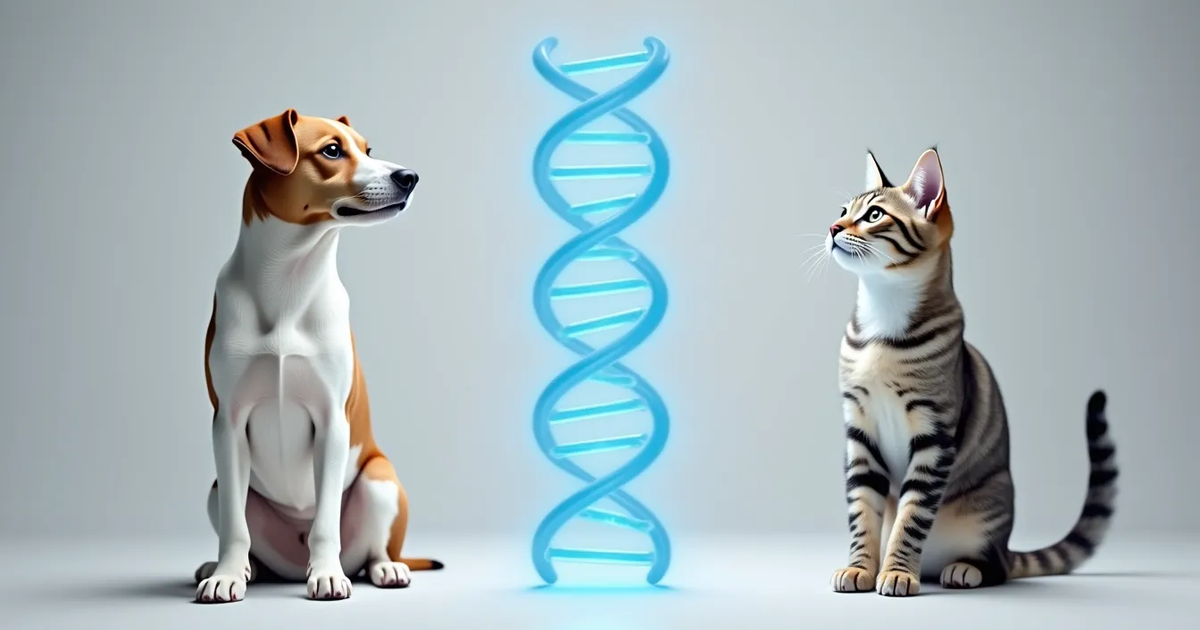
In short: a pet DNA test tells you your dog’s or cat’s breed and ancestry, physical traits, and carrier status or risk markers for certain hereditary conditions — as information, not a diagnosis. Fur Baby Gene explains what these tests can — and cannot — reveal, based only on peer-reviewed research, treating results as probability rather than destiny. This English edition is written for owners in the United States and the United Kingdom, so it also covers which kits actually ship where you live, how results move through the US and UK veterinary referral systems, what insurers do with hereditary conditions, and what these tests are — and are not — regulated as. For any diagnosis or treatment, always consult a veterinarian.
Start here: Dog DNA Test: What It Can and Cannot Tell You, According to Research — a plain-language review of what a test actually measures, how far to trust breed results, why “at risk” is not a diagnosis, and how to choose a test in the US or the UK.
- About Fur Baby Gene
- What we cover
- Why these four breeds matter in the US and the UK
- Recommended: which test works where you live
- What to do with your results: the US and UK vet pathways
- Pet insurance: check the policy wording before you test
- Where these tests sit legally in the US and the UK
- Latest articles
- Primary sources we build on
- Frequently Asked Questions (FAQ)
- About the author
About Fur Baby Gene
Fur Baby Gene is a research-first, aggregator-style resource. A non-veterinarian editorial team reads the primary literature — PubMed-indexed studies, veterinary journals, and databases such as OMIA — and rebuilds it into plain-language articles about specific breeds and genes. We do not sell tests, publish testimonials, or run supplement ads. Every article rests on five or more tier‑1/2 sources and ends with a full reference list. For any diagnosis, medication, or treatment decision, always consult a veterinarian.
What we cover
Each topic is written for the breeds in which the variant matters most. This English edition is researched for readers in the US and the UK: the sections below deal with US and UK test availability, veterinary referral routes, insurance wording, registry rules and regulation, none of which carry over from our other language editions. The English edition currently covers:
| Species | Gene | Condition | Featured breed | Read |
|---|---|---|---|---|
| Dog | ABCB1 (MDR1) | Drug (multidrug) hypersensitivity | Australian Shepherd | Read the article |
| Dog | SOD1 | Degenerative myelopathy (DM) | Boxer | Read the article |
| Cat | MYBPC3 | Hypertrophic cardiomyopathy (HCM) | Maine Coon | Read the article |
| Cat | PKD1 | Polycystic kidney disease (PKD) | Persian | Read the article |
Why these four breeds matter in the US and the UK
The breeds above were not chosen at random. In the American Kennel Club’s 2025 most-popular breed rankings, the Australian Shepherd sits at No. 14 and the Boxer at No. 18 — both firmly inside the top 20 by US registration volume. That makes ABCB1 (MDR1) drug sensitivity and SOD1-associated degenerative myelopathy practical concerns for a large number of American households, not rare-breed curiosities.
In the UK the picture is different, and the registry structures differ too. The Kennel Club publishes quarterly and ten-yearly breed registration statistics by breed group, which is the place to check how common a breed actually is in Britain before you extrapolate from US numbers. More importantly for testing, the Kennel Club’s Assured Breeder Scheme sets required and recommended health screening and DNA tests breed by breed, and the requirement list is reviewed with breed clubs twice a year. It is the only UK dog-breeder certification scheme accredited by UKAS.
For cats, the UK position is unusually concrete. The Governing Council of the Cat Fancy (GCCF) gene testing guidance states that Maine Coons on the Active (Breeding) Register must be proven negative for HCMmc, SMA and PKDef, and it deliberately uses the term “HCMmc” rather than plain “HCM”, because the DNA test covers only one specific gene — a cat that is HCMmc-negative can still develop hypertrophic cardiomyopathy by another route. GCCF also notes that a PKD test has been available since 2005 and that Persian PKD prevalence fell substantially afterwards. That is exactly the “probability, not destiny” distinction our Maine Coon and Persian articles are built around. In the US, the Cat Fanciers’ Association operates as a registry and show authority rather than a body that mandates DNA tests.
One frequent misunderstanding worth correcting for US readers: the AKC DNA programme is about parentage verification and genetic identity, and the AKC states it does not report the presence or absence of genetic disease. US breed health screening runs instead through the Canine Health Information Center (CHIC), co-sponsored by the Orthopedic Foundation for Animals and the AKC Canine Health Foundation, where each breed’s parent club defines the required screening panel.
Recommended: which test works where you live
Start with our service comparison table for the full list, but if you are in the US or the UK, three companies cover most of the ground. Prices below were observed on 27 July 2026 and move frequently with promotions, so treat them as a range rather than a quote.
Embark (dogs only). Its Breed + Health kit covers 400+ breeds and 270+ genetic health risks, with results typically 2–4 weeks after the lab receives the swab, at $129 on offer against a $199 list price with free US shipping. There is no dedicated Embark UK site — the /uk path does not resolve — so UK buyers generally source kits through Amazon.co.uk and return the swab to Embark’s US laboratory. That international return leg is the practical catch: cross-border biological samples can sit in customs long enough to affect viability, and no GBP list price is published.
Wisdom Panel (dogs and cats, Mars Petcare). This is the only one of the three with a genuine UK operation. Wisdom Panel Premium covers 430+ breeds, 260–265+ genetic health conditions and 50+ traits; turnaround is quoted as 2–3 weeks on the US site and 3–4 weeks on the UK site. It costs $127.99 on offer ($159.99 list) in the US and £144.99 in the UK. Critically for British owners, Wisdom Panel runs UK laboratories with a UK prepaid mailer, and the company explicitly warns not to use that UK prepaid envelope from outside the UK. No customs step, no international transit risk. Its cat product, Wisdom Panel Complete for Cats, screens 45+ genetic health conditions, 70+ breeds and populations and 25+ traits and also reports blood type, with 2–3 week turnaround at $103.99 on offer ($129.99 list); it is stocked by UK retailers, though we could not verify a current official GBP figure, so check the retailer price at the point of purchase.
Basepaws (cats only, Zoetis). Its Breed + Health panel reads 64 genetic markers to report carrier status and predisposition across 43 diseases, plus 21 breeds, 25 traits and a genetic dental-health report. Turnaround is the longest of the three at 4–6 weeks, priced at $99.99 on offer against a $159.00 list. Basepaws ships internationally for $15, but international return postage is not included (US customers get a prepaid label; UK customers do not), and the company states it cannot guarantee whether customs taxes or duties will be charged.
On price and payment. A full breed-plus-health panel from these three sits broadly in the $100–$200 band in the US, and around £145 for the one product with genuine UK pricing. Panels cost more than single-variant tests because they run a genome-wide array covering hundreds of markers at once rather than genotyping one locus. All three sell direct by card from their own sites; Embark and Basepaws price in USD only, so a UK buyer additionally absorbs currency conversion and any duty, while Wisdom Panel quotes in GBP with UK-domestic returns. For UK readers that difference in logistics is usually worth more than the headline price gap.
What to do with your results: the US and UK vet pathways
A test report is a starting point for a conversation with a veterinarian, not a substitute for one. Print or download the PDF and bring the exact variant nomenclature — for example ABCB1 nt230(del4) rather than just “MDR1 positive” — because the specific variant determines what, if anything, is clinically relevant.
In the US, you take that report to a general-practice vet first. AAHA accreditation is a reasonable quality signal when choosing a practice: it is voluntary, measured against roughly 900 standards, re-evaluated every three years, and held by only about 15% of US animal hospitals. If the finding needs specialist input, your vet refers you to a board-certified diplomate — the American College of Veterinary Internal Medicine (ACVIM) certifies specialists in cardiology, internal medicine, neurology and oncology, which covers most of the conditions we write about, while the American College of Veterinary Ophthalmologists (ACVO) covers inherited eye disease.
In the UK, specialist access is formally gated by referral. Your first-opinion vet refers you onward, and the Royal College of Veterinary Surgeons (RCVS) Specialist list defines who may be described as a Specialist: at minimum a postgraduate Diploma-level qualification plus active contribution to and recognition within the field, with a separate Advanced Practitioner tier below it. UK vets may not describe a colleague as a “Specialist” or “Advanced Practitioner” unless they appear on the relevant RCVS list, and RCVS guidance on referrals places the duty on the referring vet to tell you which status the referral vet holds. If you are in Britain, the practical implication is simple: do not try to book a referral centre directly — go through your own practice.
Pet insurance: check the policy wording before you test
This is the most commonly missed step, and it works differently on each side of the Atlantic. In the US, Trupanion covers hereditary and congenital conditions on its standard policy provided no signs appeared before the effective date, and Healthy Paws takes the same approach while making the crucial point explicit: a condition does not need to have been diagnosed to count as pre-existing — symptoms present before enrolment are enough. Nationwide also excludes pre-existing conditions, and its hereditary coverage depends on which plan you buy and on enrolment-age limits, so it cannot be assumed.
In the UK, the equivalent question is whether you hold a lifetime policy. Petplan’s Covered For Life structure refreshes the annual vet-fee limit at each renewal, so an ongoing condition can be claimed for year after year as long as cover is renewed without a break — which matters enormously for a chronic hereditary condition. Petplan assesses pre-existing conditions case by case rather than with a blanket rule, but states that where a condition is likely to affect the animal for the rest of its life, it would not be able to cover costs attached to that ailment. ManyPets defines a pre-existing condition as “any medical problem your pet has had signs of, or needed vet advice, medication or treatment for, before taking out your pet insurance plan,” and unusually does not treat a condition that ended more than two years ago as pre-existing.
Read those definitions carefully, because they turn on clinical signs, advice or treatment before the policy starts. None of the insurers we reviewed states that a genetic carrier or risk result on its own creates a pre-existing condition, and we are not going to claim otherwise. What follows logically is narrower but still worth acting on: if testing leads to a veterinary consultation, documented signs or a diagnosis before cover begins, that condition would fall under the standard pre-existing exclusion. If you are weighing up both a DNA test and a policy, check the hereditary and congenital clause in the specific wording first, and speak to your vet and insurer about sequencing.
Where these tests sit legally in the US and the UK
Neither country regulates consumer pet DNA tests as clinical diagnostics. In the US, the FDA does not oversee direct-to-consumer animal genetic tests the way it oversees human DTC genetic tests; these kits are not FDA-approved or cleared to detect, diagnose or prevent disease, and the accuracy figures companies advertise are their own internal validation rather than a federally set standard. The most-cited critique remains the 2018 Nature commentary by Moses, Niemi and Karlsson, “Pet genomics medicine runs wild”, which warned that the field is essentially unregulated, that it is too easy to sell false hope, and that the sector needs quality standards for how tests are run and reported plus genetic counselling to interpret them. That is precisely why we treat every result as probability.
The UK has no DNA-test-specific regulation either. What it does have is a breeder and seller licensing regime: the Animal Welfare (Licensing of Activities Involving Animals) (England) Regulations 2018, extended by the 2019 amendment regulations known as Lucy’s Law, in force from 6 April 2020, which bar licensed sellers from selling puppies and kittens under six months unless they bred the animals themselves. To be precise about scope: Lucy’s Law governs breeding and selling, not genetic testing, and says nothing about DNA panels. The nearest thing to a testing standard for UK dogs is contractual rather than statutory — the Kennel Club Assured Breeder Scheme requirements described above, which oblige Assured Breeders to complete the BVA/KC screening and DNA tests specified for their breed.
Latest articles





Primary sources we build on
Every Fur Baby Gene article is grounded in primary literature — peer-reviewed studies and curated genetic databases — not opinion or advertising.
- PubMed (NIH / U.S. National Library of Medicine)
- OMIA — Online Mendelian Inheritance in Animals (University of Sydney)
- Washington State University — Veterinary Clinical Pharmacology Laboratory (MDR1)
- American Kennel Club (AKC) and the Canine Health Information Center (CHIC / OFA)
- The Cat Fanciers’ Association (CFA)
- The Kennel Club (UK) — Assured Breeder Scheme and breed registration statistics
- Governing Council of the Cat Fancy (GCCF, UK) — gene testing and registration policy
- Royal College of Veterinary Surgeons (RCVS) — UK specialist and referral standards
Frequently Asked Questions (FAQ)
Q. Can a pet DNA test tell me if my pet is sick?
Most consumer DNA tests report breed/ancestry, traits, and carrier status or risk markers for some hereditary conditions. Results are information, not a confirmed diagnosis. See a veterinarian if your pet has symptoms or needs a diagnosis.
Q. Can I use the results as a diagnosis?
No. Consumer DNA tests are not intended for diagnosis. Health and treatment decisions are made by a veterinarian, who may use the results as one piece of information.
Q. What should I do once I have the results?
Take the report to a general-practice vet and bring the exact variant nomenclature — for example ABCB1 nt230(del4) rather than just “MDR1 positive” — because the specific variant determines what is clinically relevant. In the US your vet can refer you to a board-certified diplomate: ACVIM covers cardiology, internal medicine, neurology and oncology, ACVO covers inherited eye disease. In the UK specialist access is gated by referral and only vets on the RCVS Specialist list may be described as Specialists, so do not try to book a referral centre directly.
Q. Will a DNA test affect my pet insurance?
Check the policy wording before you test. In the US, Trupanion covers hereditary and congenital conditions on its standard policy provided no signs appeared before the effective date, and Healthy Paws makes the crucial point explicit: a condition does not need to have been diagnosed to count as pre-existing. In the UK the question is whether you hold a lifetime policy such as Petplan’s Covered For Life, which refreshes the annual vet-fee limit at each renewal. None of the insurers we reviewed states that a genetic carrier or risk result on its own creates a pre-existing condition.
Q. Which conditions and breeds do you currently cover?
For dogs: MDR1/ABCB1 drug sensitivity, degenerative myelopathy (DM/SOD1) and Collie eye anomaly (CEA/NHEJ1). For cats: hypertrophic cardiomyopathy (HCM/MYBPC3) and polycystic kidney disease (PKD/PKD1). Each topic is written for the breeds in which the variant is most relevant.
Q. How many sources does each article use?
Each article is built on primary literature — typically five or more tier-1/2 references such as PubMed-indexed studies, veterinary journals, and databases like OMIA (Online Mendelian Inheritance in Animals). Every article ends with a reference list you can check.
Q. Who writes this site?
A non-veterinarian editorial team that synthesizes peer-reviewed research, veterinary journals, and primary sources. We aggregate published evidence and do not diagnose or treat.
Q. Is Fur Baby Gene available in other languages?
Yes. Fur Baby Gene publishes in English, Japanese (日本語), Simplified Chinese (简体中文) and German (Deutsch). Use the language links in the header. Each language has its own articles written for that market — not machine translations.
About the author
About the author

Elena Marsh
Editor & writer (not a veterinarian)
A writer with a molecular-biology background and a lifelong dog and cat owner. Not a veterinarian — she translates peer-reviewed genetics research and primary data into plain language, always as information rather than diagnosis.
This site contains affiliate advertising and is provided for information only. It is not veterinary diagnosis, advice, or treatment, and genetic tests do not guarantee the prevention, diagnosis, or treatment of any disease. Prices, turnaround times and product specifications were observed on 27 July 2026 and change frequently; always confirm current details with the provider. Always consult a veterinarian about your pet’s health.