
Bottom line: The “white” Doberman Pinscher is a form of oculocutaneous albinism (OCA4) caused by a 4,081 bp deletion at the end of the SLC45A2 gene, inherited as an autosomal recessive trait. In a 2014 Michigan State University study of 20 white and 20 standard-colored Dobermans at two rescue facilities, all 20 white dogs squinted in full sunlight and 12 of 20 had skin tumors, all of the examined ones melanocytic, versus 1 of 20 controls; the six masses re-examined by the study pathologist were benign melanocytomas, but earlier biopsy reports from five white Dobermans included malignant melanoma diagnoses. A WZ (Z-list) registration number marks descent from one female born in 1976, not carrier status; a DNA test for the Doberman deletion answers that, but it does not detect the other SLC45A2 variants found in other breeds. A genetic result is risk information, not a diagnosis: light sensitivity, eyelid changes or new lumps on pink skin are a reason to see your veterinarian.
Product pages rarely lead with the gene symbol. The test may be listed as “Oculocutaneous Albinism (OA)”, “OCA Doberman”, “Albinism, White Doberman Pinscher” or the breeder term “Z Factor”. No published survey gives the share of US Dobermans that carry it.
- One puppy in 1976 and a letter from the AKC
- What a WZ number records, and what only a cheek swab can
- Squinting in full sun: the eye findings Michigan State recorded
- Pigmented lumps on pink skin: reading 12 of 20 against 1 of 20
- Inside the cream coat: a 4,081 bp deletion at the end of SLC45A2
- Same gene, different mutation: why a Doberman result says nothing about a “pink” Frenchie
- Ordering the deletion test from a US lab: names, prices, report codes
- Restricted, limited, disqualified: the rules buyers and breeders work under
- Caring for a white Doberman: ophthalmologist, dermatologist, pre-existing clauses
- Frequently asked questions
- Related articles
- References
- How to get your pet tested
One puppy in 1976 and a letter from the AKC
According to the Doberman Pinscher Club of America (DPCA) policy page, the first known albino Doberman was a female named Padula’s Queen Sheba, born on 10 November 1976 (AKC Reg. No. WE166747). Her sire was Rasputin VI and her dam Dynamo Humm. Both parents were black and rust, and so were her 11 littermates, according to the club’s account. A DPCA-hosted history by Judy Doniere adds that Sheba was not registered until 24 January 1979.
The registration itself became a turning point. The owner wrote “albino” in the color field. The AKC returned the papers with a letter explaining that albino is not a color, and its registration review committee recorded her color as white. The DPCA states that every purposefully bred albino Doberman since then descends directly from Sheba. Michigan State’s 2014 paper likewise traces all living white Doberman Pinschers (WDPs) to one female through extensive line breeding.
SamSo a single registration decision in the late 1970s is why white Dobermans can still get AKC papers today? Elena MarshThat is how the DPCA tells it. The club responded with a standard amendment in 1982 and a tracking code in the 1990s, but neither stops registration. The Doniere history records that the AKC Delegates declined the club’s request for something stronger.The club’s first formal response came through the breed standard. The AKC Doberman Pinscher standard, approved on 6 February 1982, ends with a single line: “Disqualifying Fault – Dogs not of an allowed color”. The standard never uses the words white or albino. A disqualification bars a dog from the conformation ring, and the DPCA’s own 2021 brochure concedes that it “does not stop the continued breeding” of these dogs.
The club also funded a $10,000 five-year study through a committee formed in November 1981 (Doniere history). Per the DPCA summary, it followed two albinistic bitches and found them photosensitive and prone to solar skin damage; its temperament remarks rest on those same two dogs and are not peer-reviewed.
What a WZ number records, and what only a cheek swab can
The Z-list is the tracking system built around Sheba. Any Doberman descended from her sire or dam receives an AKC registration number beginning with “WZ”, whatever its coat color. The AKC’s article on albino dogs says the list now holds more than 20,000 Dobermans; the date of that count is not given.
When the list began depends on whom you read. The DPCA’s “Recent Progress” update says the AKC Board approved Patti Strand’s proposal for a tracking mechanism at its 17 November 1995 meeting. Winkler and colleagues (2014) write that the AKC accepted the DPCA’s request in 1996. The DPCA policy page says “In 1998, Z-tracking became a reality”. An AKC staff file sent to the club lists WZ-numbered dogs registered from 7 February 1997. The safe summary is that Z-tracking was approved and put to use in the late 1990s.
The more important point is what the mark means. The Michigan State paper states that the conditional registration number “does not provide an indication of the actual carrier or non-carrier status of the dog”. A WZ Doberman may carry no copy of the deletion; a Doberman without the prefix is not proven free of it. The Croatian lab AnimaLabs notes on its test page that, because Sheba’s parents were not closely line-bred, Dobermans outside her pedigree could also carry the variant. No data confirm or rule that out.
| Question | WZ prefix on papers | SLC45A2 deletion test |
|---|---|---|
| What it reflects | Sheba’s sire or dam appears in the pedigree | 0, 1 or 2 copies of the 4,081 bp deletion |
| Source | AKC registration, requested by the DPCA | Cheek swab or blood sample at a lab |
| Identifies a carrier? | No (Winkler et al. 2014) | Yes, for this one variant |
| Covers other albinism genes? | No | No |
The DPCA brochure calls Z-tracking “along with genetic testing for the defective gene” the means to remove albinism from the breed, and advises buyers to ask to see the registration papers of both sire and dam before committing to a puppy. Those papers show the WZ prefix; a DNA report shows the genotype.
Squinting in full sun: the eye findings Michigan State recorded
The clinical anchor for this condition is Winkler, Bartoe and colleagues’ 2014 paper in PLoS One. The Michigan State team examined 20 white Dobermans and 20 standard-colored Dobermans housed at two regional Doberman rescue facilities. Every white dog showed photophobia outdoors in full sunlight, and the squinting resolved indoors in ordinary room light. None of the 40 dogs had nystagmus, an involuntary flicker of the eyes.
The examinations found reduced pigment throughout the eye and its surroundings:
- Pink or hypopigmented eyelid margins, leading edge of the third eyelid and eyelashes.
- Irises tan at the outer edge, shading to blue toward the pupil, with thinning of the iris stroma and light passing through it (transillumination).
- Hypopigmented retinal pigment epithelium and choroid at the back of the eye.
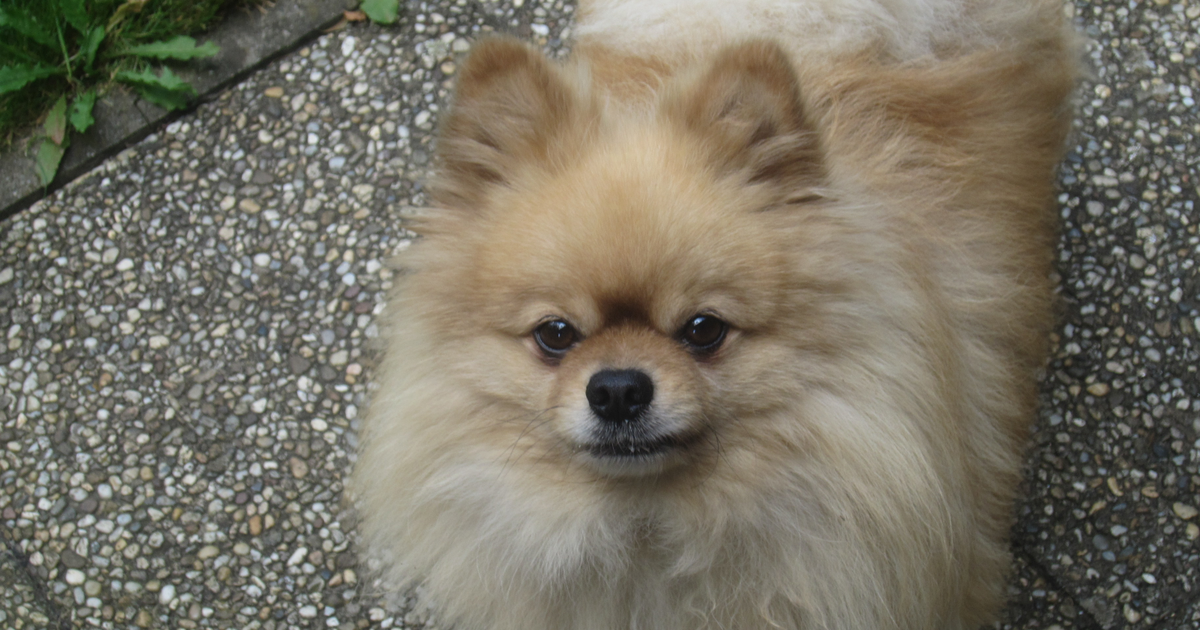
The OMIA entry for canine OCA type IV summarises the condition as including photophobia, vision defects and UV-related skin and ocular masses, and lists five breeds with reported cases: Bull Mastiff, Doberman Pinscher, Lhasa Apso, Pekingese and Pomeranian. The Doberman is the only one of the five with a controlled clinical study behind it.
Pigmented lumps on pink skin: reading 12 of 20 against 1 of 20
The finding most often repeated about white Dobermans is the tumor count. In the Michigan State group, 12 of the 20 white dogs had skin tumors, compared with 1 of the 20 standard-colored dogs (p<0.0001). The figure needs three pieces of context before it means anything.
| Detail from Winkler et al. 2014 | White Dobermans | Standard-colored Dobermans |
|---|---|---|
| Dogs examined | 20 | 20 |
| Dogs with skin tumors | 12 | 1 |
| Under 5 years old | 4 of 12 | not reported separately |
| Over 5 years old | 8 of 8 | not reported separately |
| Excised skin masses examined | 11 masses from 8 dogs, all melanocytic | – |
First, the sample is a small convenience group from rescue facilities, not a random survey of white Dobermans in US homes. Second, “tumor” here spans a range: the masses excised from three white dogs (four dermal, one oral, one in the iris) were diagnosed as amelanotic melanocytoma, a benign growth, although the authors note that earlier reports included malignant amelanotic melanoma. Third, age matters: every white dog over five had at least one tumor, while only 4 of the 12 younger dogs did. Owners told the researchers their dogs were born blemish-free and developed the growths over time.
So “60% of white Dobermans get cancer” is not what the study says. A fairer reading is that skin growths of pigment-cell origin were common in this group and rose steeply with age; the 11 examined masses showed varying signs of malignancy; the six re-examined by the study pathologist were benign melanocytomas, while earlier biopsy reports from five white Dobermans included malignant melanoma diagnoses.
The authors also flag a mechanism puzzle. If sun damage alone were responsible, they would expect squamous cell or basal cell carcinomas as well, yet the lesions they saw were melanocytic. Why missing SLC45A2 leads to pigment-cell growths is unresolved.
Inside the cream coat: a 4,081 bp deletion at the end of SLC45A2
To find the gene, the Michigan State team ruled out four albinism candidates in turn: TYR, OCA2, TYRP1 and SLC45A2. Only SLC45A2 was linked to the white phenotype. Sequencing then showed a 4,081 bp deletion that removes the last 163 bp of exon 7, the gene’s final exon, together with the region just downstream. The deletion takes out the signal that normally ends the transcript, and the predicted protein loses its normal sequence after amino acid 481, replaced by 191 new ones. In skin from white dogs, RT-PCR detected no SLC45A2 transcript at all.
SLC45A2, also known as MATP, sits on dog chromosome 4 and has seven exons (NCBI Gene ID 489236). It belongs to the group of pigmentation genes, and in people variants in the same gene cause oculocutaneous albinism type 4, described in the GeneReviews chapter by Suzuki and Okamura. The comparison stops at the gene level.
The inheritance is autosomal recessive. A white Doberman has two copies of the deletion. Its black-and-rust or red parents typically have one copy each, which fits Sheba’s own colored parents. The 2014 genotyping assay found no normally pigmented dog with two copies, and identified two carriers among the standard-colored Dobermans tested. Two carriers bred together give each puppy a one-in-four chance of two copies, the ratio UC Davis’s Veterinary Genetics Laboratory also states on its test page.
This condition is unrelated to the blue and fawn “dilute” Dobermans, whose coat thinning involves a different gene (MLPH) and a different mechanism; that story is told in our Doberman color dilution alopecia article. Nor is every pale dog an albino. Schmutz and Berryere (2007) showed that cream coats in several breeds require two copies of the recessive e allele at MC1R, and found no consistent association between cream color and SLC45A2. The practical tell is the skin around the face. The AKC describes albino dogs as having pink eye rims, lips, pads and nose and never any patch of pigment, whereas an ordinary white-coated dog usually keeps a dark nose and dark eye rims.
Same gene, different mutation: why a Doberman result says nothing about a “pink” Frenchie
The Doberman deletion was only the first of at least three independent SLC45A2 variants found in dogs. In 2015, Wijesena and Schmutz at the University of Saskatchewan tested an albino Lhasa Apso and found she did not carry the Doberman deletion. Instead, she had two copies of a single-letter change, c.1478G>A (p.G493D). The same genotype turned up in one albino Pekingese, two albino Pomeranians and one small long-haired mixed-breed dog. In 2017, Caduff and colleagues at the University of Bern found a third variant, c.1287delC, in one highly inbred Bullmastiff whose sire had been mated to its own grandmother.
| SLC45A2 variant | Breeds with reported cases | Key study | Detected by a Doberman test? |
|---|---|---|---|
| 4,081 bp deletion, exon 7 | Doberman Pinscher | Winkler et al. 2014, Michigan State | Yes |
| c.1478G>A (p.G493D) | Lhasa Apso, Pekingese, Pomeranian, mixed breed | Wijesena & Schmutz 2015, Saskatchewan | No |
| c.1287delC, exon 6 | Bullmastiff (one family) | Caduff et al. 2017, Bern | No |
Not every albino dog has an SLC45A2 change at all. The albino Pug in the Saskatchewan study had the normal sequence at position 493, and the authors wrote that the variant does not explain all albinism in dogs. In German Spitz, the Bern group traced an albinism-like coat to a different gene, OCA2. A separate OMIA entry links the TYR gene to a Himalayan-type pattern.
SamSo if my Doberman tests clear, can I say she can never have an albino puppy? Elena MarshYou can say she carries no copy of the Doberman deletion. The Saskatchewan and Bern studies show the same gene can fail in other ways, and the Pug case shows other genes can too. A clear result covers one variant only.Animal Genetics makes the split concrete by selling two separate products. Its Doberman test is listed under disorder tests; its “Albinism (Small Breed Type)” test for c.1478G>A is listed under color tests, and the page says plainly that this variant is not responsible for albinism in the Bullmastiff or the Doberman Pinscher. The same page notes that in French Bulldogs and Pugs the variant is often called “pink”. European labs use yet other names, such as “C-locus (OCA4)” for the Bullmastiff test or “caL” for the small-breed variant.
Ordering the deletion test from a US lab: names, prices, report codes
Product pages vary in how clearly they name the variant. Prices below were read on 20 October 2026 unless noted; none of the US pages stated sales tax or shipping.
| Lab / product | Variant named | Price | Turnaround | Report codes |
|---|---|---|---|---|
| UC Davis VGL, OCA in Doberman Pinschers | Large deletion in SLC45A2 | $55 per animal (October 2025 archived page; live page blocked) | At least 15 business days | N / OCA |
| Paw Print Genetics, test #204 (Doberman Pinscher Type) | SLC45A2; aka Z Factor, WDP | Not retrieved | Not retrieved | – |
| Animal Genetics, Oculocutaneous Albinism (OA) | 4,081 bp deletion | $45.00 | 3-5 or 7-10 business days | n/n, n/OA, OA/OA |
| Wisdom Panel Premium | “Albino” trait in SLC45A2, variant not named | $127.99 sale ($159.99 regular) | – | – |
| AnimaLabs (Croatia), Doberman Pinscher Type | c.1442_*3934del | EUR 54.90 incl. VAT | – | – |
The UC Davis Veterinary Genetics Laboratory listed its Doberman OCA test at $55 in an October 2025 archived copy, with a cheek or gum brush sample; its live page could not be loaded for this article, so confirm the current price. The same page lists a $130 Doberman Pinscher Health Panel whose contents we did not capture. Paw Print Genetics’ archived test #204 lists “Z Factor” among its alternative names, which is how many US breeders still refer to the trait; the company’s homepage now says it is merging with Orivet, and current ordering for this test is unconfirmed.
The Animal Genetics OA test page lists Doberman Pinscher and mixed breed dogs and cites Winkler 2014. Its report uses n/n for a dog with no copy, n/OA for a carrier and OA/OA for an affected dog.
Wisdom Panel’s “Albino” trait names no variant, so do not assume it reads the Doberman deletion, and we found Embark pages only for the Bullmastiff and small-breed variants. Neither the OFA nor its CHIC program lists albinism among Doberman health screens, so a DNA result for this trait will not appear on a dog’s CHIC record.
Restricted, limited, disqualified: the rules buyers and breeders work under
We found no US federal or state law that addresses breeding albino dogs or dogs of a disqualifying color, though that search was not exhaustive. The rules that do apply are private ones, set by the AKC and the DPCA.
The DPCA’s position is direct. Its policy page says the club “strongly opposes” the breeding of Dobermans without regard for health and welfare, including breeders who breed albino Dobermans, and reports a member poll in which 98.8% of 1,153 votes opposed breeding and registering them. An older DPCA policy document recommends that white dogs, their parents and their littermates not be bred, and that they be spayed or neutered with limited or no registration. These are club recommendations, not AKC rules.
The club asked the AKC for more. In 1994-95 it sought “Restricted Registration”, which would have been assigned automatically to dogs of a disqualifying color if a parent club voted for it by at least 75%. The Doniere history reports a 99.6% member vote in favour, and that the AKC Delegates turned the request down. What remains is AKC Limited Registration, under which a dog is registered but its litters cannot be. The litter owner chooses it, not the club, so it depends entirely on the breeder.
SamIf I’m buying a puppy, what can I actually check before paying a deposit? Elena MarshThe DPCA brochure suggests asking to see the registration papers of both parents, which will show any WZ prefix. Since Michigan State showed the prefix does not reveal genotype, a DNA report for the deletion on both parents is the stronger document.The Doberman Pinscher ranked No. 15 among 202 breeds in the AKC’s 2025 registration statistics, yet no peer-reviewed survey of the deletion in US Dobermans was found. A carrier percentage quoted for this variant is one we could not trace.
Caring for a white Doberman: ophthalmologist, dermatologist, pre-existing clauses
If you already share your home with a white Doberman, the Michigan State findings point to two specialties. Squinting, eyelid changes or a visible mass in the iris are reasons to ask your regular veterinarian about an eye specialist. The American College of Veterinary Ophthalmologists (ACVO) runs an ophthalmologist search tool and describes its diplomates as working alongside general practice vets.
Growths on pink skin, lips or eyelids deserve prompt attention, since 11 of 11 excised masses in the white dogs were of pigment-cell origin. Your veterinarian can decide whether a lump needs sampling or removal, and may suggest a board-certified dermatologist through the ACVD directory. Sun management and any treatment are decisions for your vet; a DNA result does not diagnose these problems.
Insurance is where a white coat creates a specific difficulty: the sign is visible from birth. Under the definitions in the NAIC Pet Insurance Model Act, a pre-existing condition can include signs or symptoms present before the policy’s effective date, and a congenital disorder is one present from birth.
- Embrace covers hereditary and congenital conditions “when not pre-existing”, counts any irregularity noticed by you or your vet before the waiting period ends, and does not cover DNA testing.
- Nationwide states that pre-existing conditions are not covered.
Whether an insurer would treat a melanocytic tumour that appears years later as part of a pre-existing albinism condition is not addressed in any policy text we found. Ask the insurer in writing before enrolling, and keep the answer. The NAIC model also states that a condition covered under a policy cannot be reclassified as pre-existing on renewal.
Frequently asked questions
Q. Does a negative Doberman OCA test prove my dog cannot produce an albino puppy?
No. It shows the dog carries no copy of the 4,081 bp Doberman deletion. Other SLC45A2 variants exist in other breeds, and at least one albino dog (a Pug) had no known SLC45A2 change. For a diagnosis of any eye or skin condition, see your veterinarian.
Q. Is every Doberman with a WZ registration number a carrier?
No. The WZ prefix records descent from Sheba’s sire or dam. Michigan State’s 2014 paper states that it says nothing about actual carrier status, which only a DNA test can show.
Q. Are white Dobermans deaf or red-eyed?
Hearing was not part of the Michigan State study. The AnimaLabs test page states white Dobermans are not deaf. Their irises were tan at the edge and blue toward the pupil, not red.
Q. Will a white Doberman definitely get skin cancer?
Not definitely. In a rescue-facility sample, 12 of 20 white dogs had skin tumours; the six masses re-examined by the study pathologist were benign melanocytomas, but earlier biopsy reports from five white Dobermans included malignant melanoma diagnoses. The rate rose with age. Any new lump should be checked by a veterinarian.
Q. My cream Pomeranian has a black nose. Could a Doberman OCA test tell me anything?
No. Albino Pomeranians in the 2015 Saskatchewan study carried a different SLC45A2 variant, c.1478G>A, which the Doberman test does not read. A dark nose and eye rims also point toward an ordinary cream coat rather than albinism.
Q. Does the OFA keep a database of Doberman albinism results?
Not as part of CHIC. The OFA Doberman screening list covers hips, advanced cardiac exams, thyroid, vWD, the DPCA Working Aptitude Evaluation and an ACVO eye exam, with no albinism row.
Related articles
Related inherited-disease articles and the test-service coverage table.


Read about the same gene in other languages
References
- Winkler PA, Gornik KR, Ramsey DT, Dubielzig RR, Venta PJ, Petersen-Jones SM, Bartoe JT (2014). A partial gene deletion of SLC45A2 causes oculocutaneous albinism in Doberman pinscher dogs. PLoS One 9(3):e92127.
- Wijesena HR, Schmutz SM (2015). A missense mutation in SLC45A2 is associated with albinism in several small long haired dog breeds. J Hered 106(3):285-288.
- Caduff M, Bauer A, Jagannathan V, Leeb T (2017). A single base deletion in the SLC45A2 gene in a Bullmastiff with oculocutaneous albinism. Anim Genet 48(5):619-621.
- Caduff M, Bauer A, Jagannathan V, Leeb T (2017). OCA2 splice site variant in German Spitz dogs with oculocutaneous albinism. PLoS One 12(10):e0185944.
- Schmutz SM, Berryere TG (2007). The genetics of cream coat color in dogs. J Hered 98(5):544-548.
- Suzuki T, Okamura K. Oculocutaneous Albinism Type 4. In: Adam MP, Bick S, Mirzaa GM, et al., editors. GeneReviews. Seattle (WA): University of Washington, Seattle; 1993-.
- OMIA 001821-9615: Coat colour, albinism, oculocutaneous type IV in Canis lupus familiaris (dog). Online Mendelian Inheritance in Animals, University of Sydney.
- NCBI Gene ID 489236: SLC45A2 solute carrier family 45 member 2 [Canis lupus familiaris].
- Doberman Pinscher Club of America. About Albino Dobermans (policy, history, Z-tracking).
- American Kennel Club. Can Dogs Be Albino? (AKC Expert Advice, Health).
How to get your pet tested
Some pet DNA tests screen for hereditary-disease carrier status or genetic risk markers, but the results are information, not a diagnosis. If your pet has symptoms or you need a confirmed diagnosis, please consult your veterinarian.
Below is where Oculocutaneous albinism (OCA4 / SLC45A2) can be tested, grouped by where you live and marked by whether each service explicitly lists this variant (✅ = listed / ❓ = unverified / ❌ = not offered).
In the United States
In the United Kingdom
In India
Elsewhere
Note: even if the kit can be purchased/shipped internationally, the service itself (sample return, analysis, results) is not guaranteed in your country. Check each service’s stated service area and sample-return method before ordering.
Services offered in other regions (may not be available where you live)
Worried about your pet’s health? — Talk to a veterinarian
A confirmed diagnosis and any treatment plan are decisions for a veterinarian, not a test kit. The links below are professional resources.
AVMA — Find a veterinarian (American Veterinary Medical Association)
This section contains advertising (affiliate links); we may earn a commission if you buy through them. As an Amazon Associate, we earn from qualifying purchases. Genetic tests do not guarantee the prevention, diagnosis, or treatment of any disease — results indicate tendencies and provide information only.
This page is educational information, not veterinary diagnosis or advice. Always consult a veterinarian about your pet’s health.
About the author
Elena Marsh
Editor & writer (not a veterinarian)
A writer with a molecular-biology background and a lifelong dog and cat owner. Not a veterinarian — she translates peer-reviewed genetics research and primary data into plain language, always as information rather than diagnosis.