Bottom line: Of every Burmese-derived breed that has been surveyed, the Bombay carries the heaviest burden of hypokalaemic periodic polymyopathy. Malik et al. (2015, Journal of Feline Medicine and Surgery 17(5):417-426) genotyped 124 Bombays and found 26 carriers (21%) and 9 affected cats (7%). Compare that with the parent breed: in 2,099 Burmese, only 1.6% were affected. The Bombay’s affected rate is more than four times the Burmese figure — a direct consequence of a small founding population built on Burmese lines. The cause is a single nonsense variant, WNK4 c.2899C>T (p.Gln967*), identified by Gandolfi et al. (2012, PLoS ONE 7(12):e53173). It is autosomal recessive, so two clinically normal parents can produce an affected kitten. One ordering note that matters in practice: this is a breeding test, not an emergency test. If your Bombay is weak right now, with its head hanging toward its chest, the answer is a veterinary visit and a serum potassium plus CK measurement today — not a cheek swab that takes weeks. The good news is that the disease is manageable with potassium supplementation, which is exactly why “wait and see” is the wrong instinct.
Why the Bombay’s numbers look worse than the Burmese
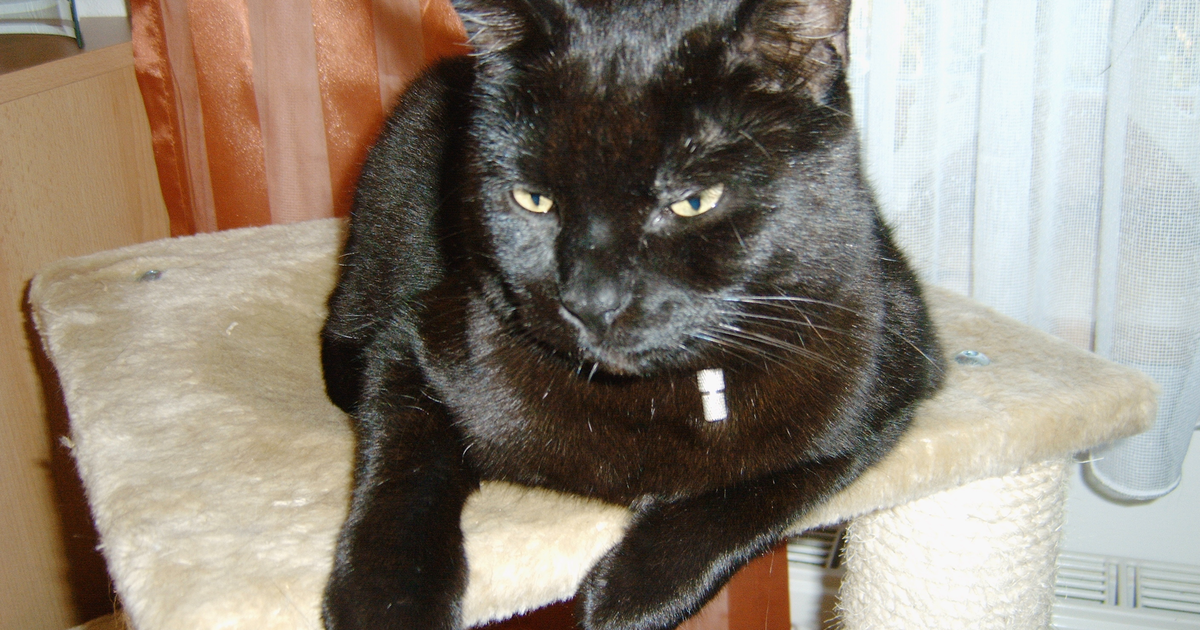
The Bombay was created in the United States — Nikki Horner began the programme in Louisville, Kentucky, aiming for a “miniature black panther” by crossing sable Burmese with black American Shorthairs. That origin story is charming, and it is also the reason this variant matters so much in the breed.
A breed founded on a narrow slice of Burmese lines inherits whatever those lines were carrying. There is no mechanism that filters out a recessive variant during breed creation; if the founders carried it, the new breed carries it at a similar or higher frequency, and a small population size lets it drift upward.
The survey data make the point cleanly. Here is what Malik et al. (2015) found across breeds tested between 2012 and 2014:
- Bombay — 124 tested: 89 normal (72%), 26 carriers (21%), 9 affected (7%)
- Burmese — 2,099 tested: 1,654 normal (79%), 411 carriers (20%), 34 affected (1.6%)
- Burmilla — 133 tested: 17 carriers (13%), 0 affected
- Tiffanie — 21 tested: 7 carriers (33%), 0 affected
- Tonkinese — 19 tested: 1 affected (5%)
- Australian Mist — 31 tested: no carriers, no affected
Read the carrier column and the affected column separately. The Bombay’s carrier rate (21%) is essentially the same as the Burmese (20%) — but its affected rate is 7% against 1.6%. That gap is not about the variant being different. It is about how often carriers were mated to carriers in a numerically small breed. It is, in other words, a population-structure problem, and population-structure problems are the kind that testing actually solves.
What the variant does inside the kidney
SamHow does a kidney gene end up causing muscle weakness? Elena MarshThe kidney dumps potassium into the urine, blood potassium falls, and muscle cannot depolarise normally. The muscle is the victim, not the cause.

Gandolfi et al. (2012) ran a genome-wide association study on hypokalaemic and healthy Burmese cats, found a significant signal on cat chromosome E1, and sequenced candidate genes in that interval. The hit was in WNK4 — a kinase that regulates renal potassium handling.
The variant c.2899C>T creates a premature stop codon. The resulting protein is truncated and lacks both the C-terminal coiled-coil domain and the conserved Akt1/SGK phosphorylation site — the site through which the kinase is normally switched off. Losing the off-switch is thought to leave the kinase constitutively active, producing a potassium-losing nephropathy.
Two honest caveats. First, that mechanism is extrapolated from the human and mouse orthologues; it has not been proven end-to-end in the cat. Second, some sources cite the variant as c.2902C>T rather than c.2899C>T — a transcript-numbering difference, not a different mutation. Laboratories test the same nonsense change.
Recognising an episode — and filming it
Onset is usually early. Gandolfi et al. (2012) describe signs becoming evident at two to six months of age, though some cases went undetected until two years. Wisdom Panel’s clinical summary puts the usual window at two to ten months.
What an owner actually sees:
- Ventroflexion of the head and neck — the chin drops toward the chest and the cat cannot lift it. This is the single most characteristic sign
- Head bobbing
- Dorsal protrusion of the scapulae — the shoulder blades stand up out of the back
- A stiff, stilted gait and muscle tremor
- Episodes that come and go, sometimes resolving before you can get to a clinic
That last point is the practical trap. Film it. A ten-second phone video of a ventroflexed neck is worth more to your veterinarian than any description you can give, and it survives the drive to the clinic when the episode does not.
Diagnosis rests on low serum potassium with elevated creatine kinase during an episode. Langford Vets at the University of Bristol defines the condition in exactly those terms. The DNA test tells you the genotype; it does not tell you whether today’s weakness is an episode.
Ordering the test in the US and the UK
SamMy Bombay came from a breeder who says the line is clear. Is that enough? Elena MarshAsk for the certificate with the cat’s own microchip number on it. “The line is clear” is a claim about ancestors, not about your cat.In the United States, the two routes are a standalone test or a panel:
- UC Davis Veterinary Genetics Laboratory runs a dedicated Burmese Hypokalemia test and lists it as appropriate for Australian Mist, Bombay, Burmese, European Burmese, Burmilla, Cornish Rex, Devon Rex, Singapura, Sphynx, Tiffanie and Tonkinese. Owner-orderable, cheek swab, samples accepted internationally
- Wisdom Panel Complete for Cats — a cheek-swab panel covering 45+ genetic health conditions including familial episodic hypokalaemic polymyopathy, listed at $129.99 (retailers such as Chewy have run it at $103.99). Sensible if you also want blood type and the rest of the panel
- Orivet offers a standalone feline Hypokalaemia (Periodic Polymyopathy) — Burmese test within its breeder catalogue
In the United Kingdom, the picture is different in one important way: the test is embedded in registration policy. Under the GCCF Registration Policy for Burmese Cats, a Hypokalaemia Polymyopathy Testing Scheme took effect on 1 January 2023: Burmese may be entered on the Active Register only if the cat itself has tested normal. If you are importing a Bombay or a Burmese into a GCCF programme, that requirement — the cat itself, not its parents — is the one to plan around.
UK laboratories:
- Langford Vets — the lab that launched the test with the University of Bristol. Mouth swab for owners; for ICC/GCCF registration a veterinarian must take the sample and verify identity by microchip number
- Laboklin UK sells a Burmese DNA bundle at £72.00 including VAT, covering hypokalaemia (BHK), head defect, GM2 gangliosidosis and genetic blood group. For a breeding cat, bundling is usually better value than four separate orders
On insurance: US and UK policies differ sharply here, and the difference is worth money. Most UK lifetime policies exclude conditions that are hereditary or that showed signs before cover started, while several US insurers do cover hereditary conditions provided they are not pre-existing. Either way the operative word is pre-existing — once “episodic weakness” is in the clinical record, that door closes. If you have a Bombay kitten from an untested line, arrange cover before you go looking for symptoms, and read the hereditary-condition clause rather than the marketing page.
Living with a positive result
An affected diagnosis is not a catastrophe. Treatment is potassium supplementation, and International Cat Care describes the condition as manageable on that basis. Most cats stabilise on oral potassium; severe episodes may need intravenous correction. Never supplement on your own initiative — potassium is dangerous in excess, and dosing is set against blood values by a veterinarian.
For breeders, the arithmetic is simple and forgiving. Carrier × clear produces no affected kittens. Only carrier × carrier does, at 25%. With a 21% carrier rate, removing every carrier Bombay from the gene pool would gut a breed that is already small — and would trade one health problem for a worse one. The message from Malik et al. is that elimination is achievable through mate selection, not through culling carriers.
Frequently asked questions
Q. Will a carrier Bombay ever become ill?
No. The condition is autosomal recessive, so only cats with two copies are affected. Carriers are clinically normal but pass the variant to roughly half their kittens.
Q. Why is the affected rate in Bombays so much higher than in Burmese?
Because the carrier rates are similar (21% vs 20%) but the Bombay population is far smaller, so carrier-to-carrier matings happened more often. It is a population-size effect, not a different mutation.
Q. My cat is having an episode right now. Should I order a DNA test?
No — go to a veterinarian. Serum potassium and creatine kinase can be measured the same day. A DNA result takes weeks and will not change today’s treatment.
Q. Does a clear certificate for the parents cover my kitten?
Only if both parents were tested clear, in which case the kitten cannot inherit two copies. A certificate for one parent, or a claim that “the line is clear”, does not.
Q. Is the test the same on both sides of the Atlantic?
Yes — laboratories test the same WNK4 nonsense variant. What differs is who may take the sample: UK registry submissions require veterinary sampling with microchip verification.
Q. Which other breeds should be tested?
Any breed built on Burmese lines: Burmese, Burmilla, Tonkinese, Tiffanie, Asian, and per laboratory breed lists also Australian Mist, Cornish Rex, Devon Rex, Singapura and Sphynx.
References
- Gandolfi B, Gruffydd-Jones TJ, Malik R, et al. (2012) First WNK4-Hypokalemia Animal Model Identified by Genome-Wide Association in Burmese Cats. PLoS ONE 7(12):e53173.
- Malik R, Musca FJ, Gunew MN, et al. (2015) Periodic hypokalaemic polymyopathy in Burmese and closely related cats: a review including the latest genetic data. Journal of Feline Medicine and Surgery 17(5):417-426.
- Veterinary Genetics Laboratory, University of California, Davis — Burmese Hypokalemia.
- Langford Vets, University of Bristol — Burmese Hypokalaemia.
- The Governing Council of the Cat Fancy — Registration Policy for Burmese Cats (revised 28 October 2023).
- Laboklin UK — Burmese DNA bundle (test 8715).
- Wisdom Panel — Familial Episodic Hypokalaemic Polymyopathy (Burmese).
- International Cat Care — Hypokalaemia in cats.
Image: “Bombay-Katze-Kasimir” by T. Vosgerau, public domain (scaled and cropped to 1200×630).
How to get your pet tested
Some pet DNA tests screen for hereditary-disease carrier status or genetic risk markers, but the results are information, not a diagnosis. If your pet has symptoms or you need a confirmed diagnosis, please consult your veterinarian.
Below is where WNK4 (Hypokalaemia) can be tested, grouped by where you live and marked by whether each service explicitly lists this variant (✅ = listed / ❓ = unverified / ❌ = not offered).
In the United States
In the United Kingdom
In India
Elsewhere
Note: even if the kit can be purchased/shipped internationally, the service itself (sample return, analysis, results) is not guaranteed in your country. Check each service’s stated service area and sample-return method before ordering.
Services offered in other regions (may not be available where you live)
Worried about your pet’s health? — Talk to a veterinarian
A confirmed diagnosis and any treatment plan are decisions for a veterinarian, not a test kit. The links below are professional resources.
AVMA — Find a veterinarian (American Veterinary Medical Association)
This section contains advertising (affiliate links); we may earn a commission if you buy through them. As an Amazon Associate, we earn from qualifying purchases. Genetic tests do not guarantee the prevention, diagnosis, or treatment of any disease — results indicate tendencies and provide information only.
This page is educational information, not veterinary diagnosis or advice. Always consult a veterinarian about your pet’s health.
About the author
Elena Marsh
Editor & writer (not a veterinarian)
A writer with a molecular-biology background and a lifelong dog and cat owner. Not a veterinarian — she translates peer-reviewed genetics research and primary data into plain language, always as information rather than diagnosis.