Bottom line: Neuronal ceroid lipofuscinosis (NCL) in the English Setter is an inherited, incurable brain disease associated with a CLN8 variant (a T-to-C change predicting the p.L164P missense mutation), inherited autosomal-recessively, with early onset reported around 12–18 months. A DNA test tells you a dog’s genetic carrier or breeding status — clear, carrier, or affected — not a clinical diagnosis. There is no cure. For any suspected clinical signs, consult your veterinarian or a veterinary neurologist.
What NCL is, and the English Setter CLN8 mechanism


Neuronal ceroid lipofuscinosis, sometimes called canine Batten disease, is a group of inherited neurodegenerative lysosomal storage disorders. A comprehensive veterinary review (Katz et al. 2017) describes how a genetic defect disrupts normal lysosomal degradation, so autofluorescent lipopigments made of ceroid and lipofuscin-like material — including subunit c of mitochondrial ATP synthase — accumulate progressively inside neurons. Because neurons are post-mitotic and cannot dilute this waste by dividing, the storage bodies build up and drive progressive neuronal death in the brain, cerebellum, and retina.
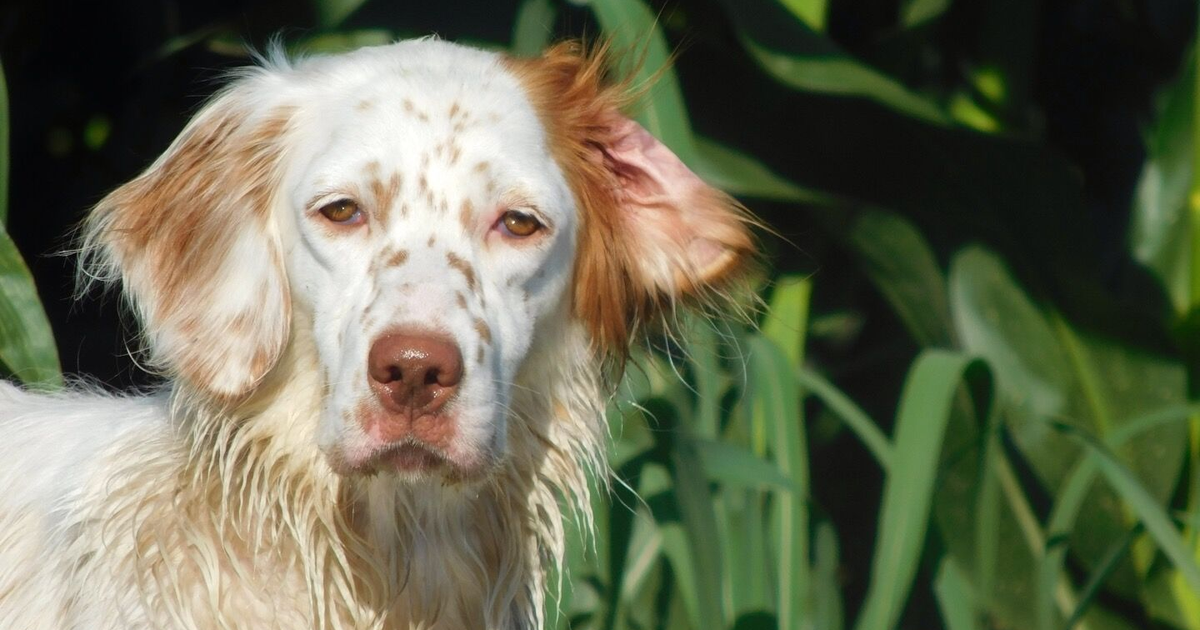
In the English Setter specifically, a 2005 study identified the molecular cause: Katz and colleagues (2005) reported a T-to-C transition in the canine CLN8 gene predicting a p.L164P missense mutation, with leucine 164 conserved across four other mammalian species. This variant is the target of the modern breed-specific “NCL8” DNA test. The English Setter is the archetypal, longest-studied canine NCL and is recognized as a model of human Batten disease.
Onset and signs in English Setters
SamWhen would signs even show up? Is it something you’d spot in a puppy? Elena MarshNot in early puppyhood — the research reports onset around 12–18 months, then progressive vision loss, behavioral change, motor decline and seizures (Katz 2005).According to the research pool, English Setter NCL has an early onset reported at roughly 12–18 months of age, followed by progressive vision loss, behavioral and personality change with dementia-like decline, motor disturbance, seizures, and premature death, with classic NCL storage pathology on examination (Katz et al. 2005). Owners often first notice that a young adult dog seems to lose learned behaviors, becomes disoriented or anxious, or bumps into objects as retinal degeneration advances. These signs are described in the literature as relentlessly progressive rather than episodic.
The English Setter’s place in medical history is notable here: the historic Koppang NCL colony, maintained from 1970, was a foundational large-animal model of human Batten disease. That long research lineage is exactly why the English Setter is so well characterized (Katz et al. 2017). If you observe any of these signs in your own dog, they are not diagnostic on their own — they warrant prompt evaluation by a veterinarian, ideally with referral to a veterinary neurologist.
Inheritance and why carrier testing matters
SamBoth my dog’s parents seemed totally healthy. Does that mean the litter is safe? Elena MarshNot necessarily — it’s autosomal recessive, and in the 2005 study all affected dogs were homozygous while carriers were clinically normal heterozygotes (Katz 2005).Canine NCL, including the English Setter CLN8 form, is inherited in an autosomal recessive pattern. That means a dog must inherit two copies of the variant to be at risk of disease, while a dog with a single copy is a clinically normal carrier. In the original 2005 study, all affected English Setters were homozygous for the CLN8 variant, all carriers were heterozygous, and 103 control dogs were normal — a pattern consistent with autosomal recessive inheritance (Katz et al. 2005).
The practical consequence is important: because carriers look completely healthy but can silently pass the variant on, DNA carrier testing before breeding is the most reliable way for breeders to avoid producing affected puppies. Testing lets a breeder identify carriers and pair them only with clear (non-carrier) mates. Parallel research in other breeds underscores the point — a 2022 screening study of over 1,000 dogs found carrier rates high enough to justify routine breeder DNA screening for NCL variants (Pervin et al. 2022) — reinforcing why carrier testing, not just visible health, guides responsible pairings.
How to test in the US and UK
SamOkay, I’m in the US — where do I even get this test, and roughly what does it cost? Elena MarshSeveral labs offer it by mail-in cheek swab; OFA’s registry documents that breed-specific NCL DNA testing is well established, processed by labs like the University of Missouri (OFA 2024).For US and UK owners, the CLN8 “NCL8” test is available from mainstream direct-to-consumer and reference laboratories. Consumer panels from Embark (which lists NCL8/CLN8 for the English Setter and related setters) and Wisdom Panel include NCL variants, while clinical-grade breed-specific testing is offered by Paw Print Genetics (now Orivet) and reference labs such as the UC Davis Veterinary Genetics Laboratory. The Orthopedic Foundation for Animals registers breed-specific NCL DNA tests, with samples processed by the University of Missouri Small Animal Molecular Genetics Lab — the lab that discovered the English Setter CLN8 variant. Most tests use a simple mail-in cheek swab you collect at home.
On price, a combined breed-plus-health DNA kit typically runs approximately $150–200 USD (roughly £120–160 GBP; verify current pricing at the point of purchase, as single-condition tests and multi-panel kits differ). On the registry side, US breeders commonly work within the American Kennel Club (AKC) framework, while in the UK the breed sits under The Kennel Club — where the English Setter has been treated as a vulnerable native breed, with annual puppy registrations hovering around the low-hundreds threshold that defines that status (verify current listing, as the breed has moved between the “vulnerable” and “at watch” lists). Two compliance points worth knowing: the US Genetic Information Nondiscrimination Act (GINA) protects people, not pets, so pet genetic results carry no such federal protection; and US pet insurance commonly excludes hereditary or pre-existing conditions, so a known genetic risk may not be covered (verify per policy). If clinical signs appear, the usual pathway is your primary veterinarian first, then referral to a board-certified veterinary neurologist.
What the DNA test tells you — and what it doesn’t
SamSo if the swab comes back “carrier” or “affected,” is that basically a diagnosis? Elena MarshNo — the research frames genotype and clinical diagnosis as separate things; the DNA result is breeding/risk information, and diagnosis is a veterinary neurologist’s job (Katz 2017).A CLN8 DNA test reports a genotype — clear, carrier, or affected — which is genuinely useful for breeding decisions and for understanding a dog’s genetic risk. What it does not provide is a clinical diagnosis, a prediction of exactly when or how severely signs would appear, or any treatment. A clinical diagnosis of NCL is made by a veterinarian, typically with input from a veterinary neurologist, based on signs, history, and appropriate work-up. The genetic result and the clinical picture answer different questions.
The most useful way to act on a result is at the breeding level: pairing a clear dog with a carrier avoids producing affected puppies while preserving the small gene pool of a numerically limited breed. NCL is not curable, so the value of testing is information — for responsible breeding choices and for informed monitoring — not a cure or a treatment plan. If your dog is showing any concerning neurological or vision changes, treat those as reasons to see your veterinarian promptly rather than as something a DNA result alone can settle.
Frequently asked questions
Q. Does a “genetically affected” DNA result mean my English Setter will definitely develop NCL?
A DNA test reports genetic status, not a clinical diagnosis. An “affected” (homozygous) result indicates the dog carries two copies of the CLN8 variant associated with English Setter NCL (Katz et al. 2005), but confirmation of disease is a matter for your veterinarian or a veterinary neurologist, not the swab alone.
Q. Where can US or UK owners get the English Setter NCL test, and roughly what does it cost?
It is available by mail-in cheek swab from labs such as Embark, Wisdom Panel, Paw Print Genetics/Orivet, and UC Davis VGL, with the OFA registry noting University of Missouri as the discovery/processing lab (OFA 2024). A breed-plus-health kit is typically around $150–200 USD (roughly £120–160 GBP); verify current pricing.
Q. Will US pet insurance cover an NCL-related condition, and does GINA protect my dog’s results?
Generally no on both counts. US pet insurance commonly excludes hereditary and pre-existing conditions (verify per policy), and the Genetic Information Nondiscrimination Act (GINA) protects humans, not pets, so pet genetic data has no equivalent federal protection.
Q. My English Setter’s parents are healthy — can the puppies still be affected?
Yes. NCL here is autosomal recessive, so two clinically normal carriers can produce affected puppies. In the original study all affected dogs were homozygous while carriers were healthy heterozygotes (Katz et al. 2005) — which is exactly why carrier DNA testing before breeding matters.
References
- Katz ML, Khan S, Awano T, Shahid SA, Siakotos AN, Johnson GS (2005) A mutation in the CLN8 gene in English Setter dogs with neuronal ceroid-lipofuscinosis. Biochemical and Biophysical Research Communications 327(2):541-547. https://pubmed.ncbi.nlm.nih.gov/15629147/
- Katz ML, Rustad E, Robinson GO, Whiting REH, Student JT, Coates JR, Narfström K (2017) Canine neuronal ceroid lipofuscinoses: Promising models for preclinical testing of therapeutic interventions. Neurobiology of Disease. https://pmc.ncbi.nlm.nih.gov/articles/PMC5675811/
- Pervin S, Islam MS, Tada N, Tsutsui T, Rahman MM, Yabuki A, Tacharina MR, Rakib TM, Maki S, Yamato O (2022) Screening and Carrier Rate of Neuronal Ceroid Lipofuscinosis in Chihuahua Dogs in Japan. Animals (Basel) 12(9):1210. https://pmc.ncbi.nlm.nih.gov/articles/PMC9106037/
- Orthopedic Foundation for Animals (2024) Neuronal Ceroid Lipofuscinosis — breed-specific DNA test registry. https://ofa.org/neuronal-ceroid-lipofuscinosis/
- Embark Veterinary — Dog health conditions (NCL8/CLN8). https://embarkvet.com/products/dog-health/health-conditions/
- University of California, Davis — Veterinary Genetics Laboratory, dog DNA tests. https://vgl.ucdavis.edu/dna-tests/dog
How to get your pet tested
Some pet DNA tests screen for hereditary-disease carrier status or genetic risk markers, but the results are information, not a diagnosis. If your pet has symptoms or you need a confirmed diagnosis, please consult your veterinarian.
Below is where Neuronal Ceroid Lipofuscinosis (NCL) can be tested, grouped by where you live and marked by whether each service explicitly lists this variant (✅ = listed / ❓ = unverified / ❌ = not offered).
In the United States
In the United Kingdom
In India
Elsewhere
Note: even if the kit can be purchased/shipped internationally, the service itself (sample return, analysis, results) is not guaranteed in your country. Check each service’s stated service area and sample-return method before ordering.
Services offered in other regions (may not be available where you live)
Worried about your pet’s health? — Talk to a veterinarian
A confirmed diagnosis and any treatment plan are decisions for a veterinarian, not a test kit. The links below are professional resources.
AVMA — Find a veterinarian (American Veterinary Medical Association)
This section contains advertising (affiliate links); we may earn a commission if you buy through them. As an Amazon Associate, we earn from qualifying purchases. Genetic tests do not guarantee the prevention, diagnosis, or treatment of any disease — results indicate tendencies and provide information only.
This page is educational information, not veterinary diagnosis or advice. Always consult a veterinarian about your pet’s health.
About the author
Elena Marsh
Editor & writer (not a veterinarian)
A writer with a molecular-biology background and a lifelong dog and cat owner. Not a veterinarian — she translates peer-reviewed genetics research and primary data into plain language, always as information rather than diagnosis.